
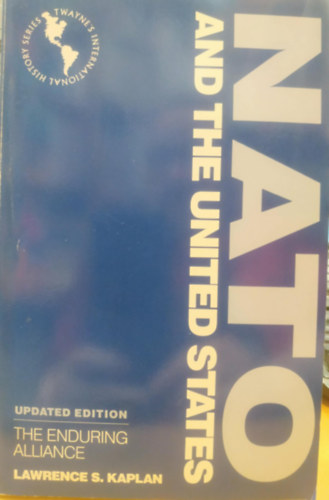

Lawrence S. Kaplan

NATO and the United States, Updated Edition: The Enduring Alliance (Twayne's International History Series)

twayne publishers, inc.  | 1994  | papír / puha kötés  |  254 oldal

Libri Antikvárium
The North American Treaty Organization (NATO) remains the indispensable link that binds America and Europe in common defense - even after the fall of communism in the former Soviet Union and its satellite countries. The North Atlantic Treaty, which established NATO after its signing in Washington, D.C., in 1949, was one of the West's primary cold war-era countermeasures against the threat of Soviet aggression. Considering a military attack on any member an attack on all its members, NATO has made its way through some 45 years of turbulence from both without and within - the Korean War (1950-53), the Soviet launching of Sputnik in 1957, the erection of the Berlin Wall in 1961, France's sudden withdrawal from the alliance in 1966 and the subsequent relocation of NATO headquarters to Brussels, SALT and START negotiations, the disintegration of the Soviet Union, the reunification of Germany, and the civil war in the former Yugoslavia. In updating his 1987 history of the United States' relations with NATO and the European interests it encompasses, the eminent NATO scholar Lawrence S. Kaplan looks at the challenges the organization faces in the 1990s, arguing that the alliance is still essential for a stable and secure Europe and that it is incumbent on the United States to maintain its NATO troop strength. U.S. participation in NATO marked a fundamental change in America's pre-World War II policy of isolationism, and Kaplan begins this study by examining the postwar mood that led Washington into the unprecedented treaty and then to the maneuvers - especially by John Foster Dulles and Arthur Vandenberg - that facilitated the progress from treaty to organization. Kaplan charts the ups and downs of U.S. involvement with NATO as he explores NATO's "New Look" in the 1950s, negotiations with the irascible Charles de Gaulle and France's exit from NATO in the 1960s, detente and the Nixon doctrine of the 1970s, the dual-track approach (promoting both new arms and arms control) of the early 1980s, the challenge posed by Mikhail Gorbachev in the mid-1980s, and the shape of the so-called new world order that emerged from the rubble of the Communist empire. The fate of the large nuclear arsenals in Russia and the Ukraine, the rise of nationalism in the former Soviet republics, and NATO membership for the former Warsaw Pact countries are crucial issues remaining on NATO's drawing board, and Kaplan's timely and comprehensive chronicle of this enduring alliance should prove essential reading for anyone interested in what Europe will look like, and how secure it will be, in the twenty-first century.
+ Mutass többet - Mutass kevesebbet
Árinformációk
Ingyen szállítás 15 000 Ft felett
Online ár: 5 990 Ft

A termék megvásárlásával

599 pontot szerezhet


Beszállítói készleten


Bolti átvétel Elérhető készlet esetén akár ma

díjmentes


Szállítás 6-8 munkanap

15 000 Ft felett díjmentes

Állapot:jó állapotú antikvár könyv
Kiadó twayne publishers, inc.
Kiadás éve1994
Oldalak száma:254
Súly400 gr
ISBN2310021298019
ÁrukódSL#2113066866
Kötéspapír / puha kötés

Vásárlói értékelések, vélemények

Kérjük, lépjen be az értékeléshez!

Árinformációk
Ingyen szállítás 15 000 Ft felett
Online ár: 5 990 Ft

A termék megvásárlásával

599 pontot szerezhet


Beszállítói készleten


Bolti átvétel Elérhető készlet esetén akár ma

díjmentes


Szállítás 6-8 munkanap

15 000 Ft felett díjmentes

Törzsvásárlói pontokkal Törzsvásárlói pontokkal